Vanotium Overview
Vanotium is a stainless steel kitchen cutting board built around what the seller calls an "Advanced Titanium Surface" — a non-porous, scratch-resistant surface marketed as antibacterial, waterproof, and dishwasher-safe, backed by a 30-day money-back guarantee.
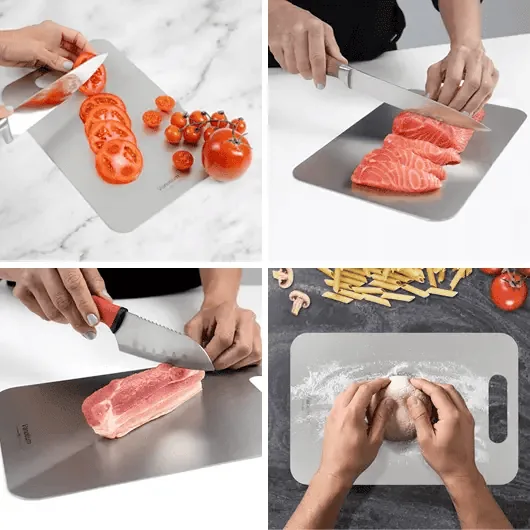
How It Works
The board is a single-piece metal surface the seller describes only as an "Advanced Titanium Surface," without naming a specific composition, alloy, or grade. The core idea behind the design is straightforward materials logic: because the surface is non-porous, it doesn't have anywhere for juices, moisture, or odors to soak in the way a wood board or a plastic board scarred by years of knife cuts can. That same smooth surface is marketed as scratch-resistant, stain-resistant, waterproof, and heat-resistant, and the seller states it's dishwasher-safe. The page also makes a food-safety claim that the surface "blocks harmful pathogens like E. coli, Salmonella" — a stronger, more specific claim than "non-porous," and one that isn't backed by any cited lab test or certification.
Why "Non-Porous" Is a Real Advantage — Even Without the Pathogen Claim
A smooth, non-porous metal surface genuinely doesn't absorb liquids or odors the way wood grain or a scarred plastic surface can — that part of the pitch is grounded in real, verifiable material behavior, not an invented benefit. What isn't verifiable from the page is the jump to an active pathogen-blocking claim naming specific bacteria; that reads like a tested antimicrobial claim, and no test or certification is cited to support it.
Who It's a Good Fit For
This suits anyone ready to retire an aging, stained, or knife-scarred plastic board, or who's tired of the oiling routine a wood board needs — a wipeable, dishwasher-safe metal surface is a real convenience upgrade over either. It's a weaker fit if you want a named material grade behind "titanium surface," or if you're particular about protecting your knives' edges, since no surface-hardness figure is published here.
Key Features & Highlights
- "Advanced Titanium Surface" (composition and grade not further specified)
- Non-porous, scratch-resistant, stain-resistant surface
- Waterproof and heat-resistant per the seller
- Dishwasher-safe, no oiling or seasoning required
- Single-piece design with an integrated handle opening
- 30-day no-hassle money-back guarantee
Getting Started
- Rinse or run it through the dishwasher after each use — no oiling or seasoning routine like a wood board needs.
- Store it hanging by the integrated handle opening, or flat away from other utensils to help protect the surface finish.
- Expect a firmer feel under the knife than wood or plastic — a normal trade-off with any hard metal cutting surface.
- Keep your order confirmation in case you want to use the 30-day money-back guarantee.
Worth knowing before you buy: the sales page doesn't specify the exact material behind "titanium surface," doesn't cite any test or certification for its E. coli/Salmonella claim, and displays an "As Seen On" press badge (including a CNN logo) that we couldn't verify against any real coverage. Our full review goes through what's verifiable and what isn't in detail.