CarbonOne Safe Overview
CarbonOne Safe is a plug-in detector that covers four hazards — carbon monoxide, natural gas, propane, and smoke — in a single unit, with a live digital display showing actual PPM readings instead of a single alarm light.
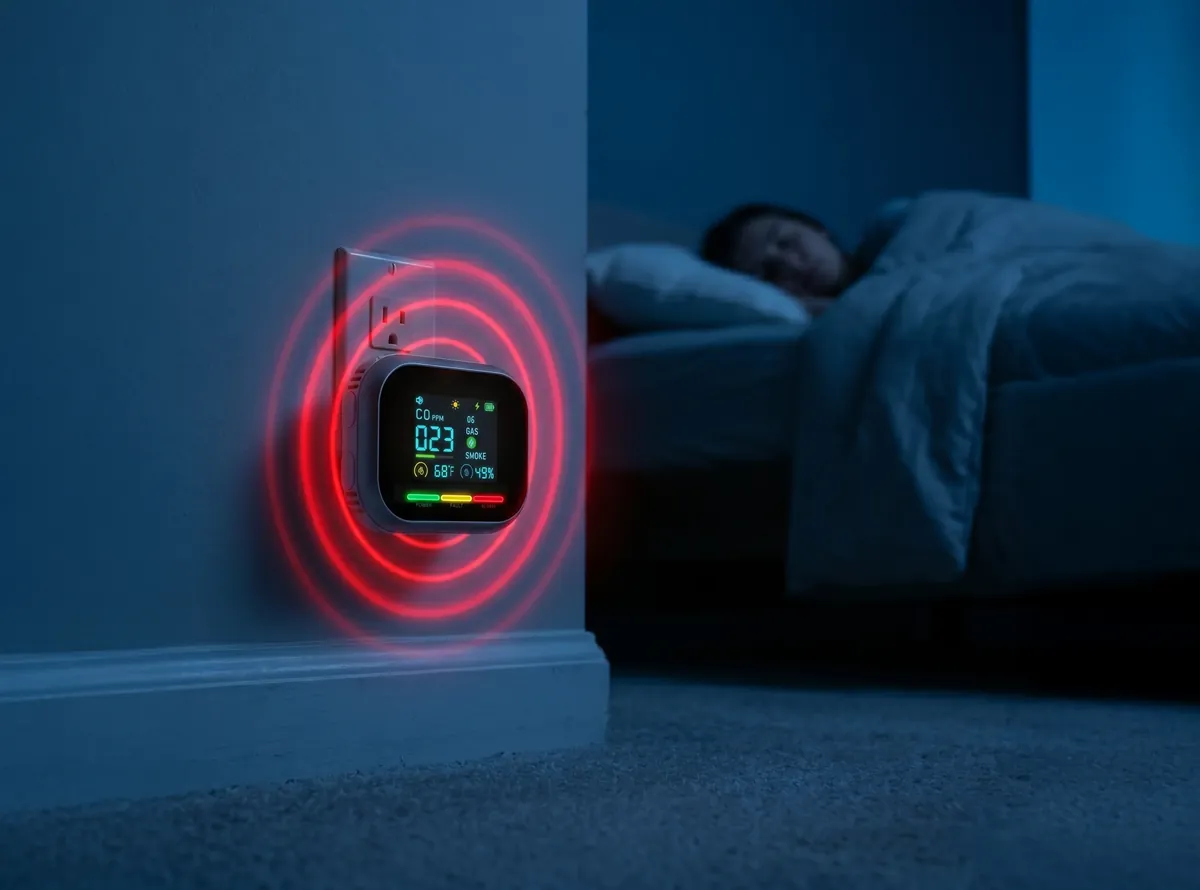
How the four-in-one detection works
CarbonOne Safe plugs directly into a standard wall outlet and starts reading within seconds — no wiring, no mounting. Sensors inside the unit monitor for carbon monoxide, natural gas, propane, and smoke from fire, feeding a live digital display on the front. Instead of staying dark until a fixed alarm threshold is crossed, the display shows the current CO level in parts per million continuously, along with separate icons for gas and smoke status and on-unit temperature and humidity. Three status lights — Power, Fault, and Alarm — give a state at a glance without reading the number.
Why a live number matters
A UL-listed CO detector is only required to sound once levels hold at 70 PPM for a sustained period, which means a home can sit at meaningfully elevated CO for hours before a legacy single-light detector reacts at all. A continuous PPM readout is built to close exactly that gap — showing a rising number long before it reaches alarm territory, rather than staying silent until it does.
Who it's a good fit for
This suits a household with gas appliances — a furnace, water heater, range, or fireplace — where CO exposure risk is genuinely highest, particularly once cold-weather months mean appliances run longer in a sealed-up home. It's also a sensible pick for anyone whose existing detector is old enough that its sensor may have quietly degraded while the light kept glowing, and for renters or anyone who wants real protection without an installation project.
Worth knowing before you buy: the sales page does not name an independent safety certification (UL 2034, CSA 6.19, ETL, or equivalent) for the CO sensor, and several of its statistics and comparisons aren't sourced. Our full review goes through what's verifiable and what isn't in detail.
Key Features & Highlights
- 4-in-1 detection: carbon monoxide, natural gas, propane, and smoke
- Live digital display — CO in PPM, plus temperature and humidity
- Power, Fault, and Alarm status lights
- Plug-in install, no tools, about 5 seconds
- Battery backup keeps monitoring during power outages
- 90-day money-back guarantee, refunded in cash minus S&H
Setup, start to finish
- Choose a standard wall outlet near a gas appliance, in a hallway, or outside a sleeping area.
- Plug the unit in directly — no tools or wiring required.
- Confirm the display lights up and shows a live reading within seconds.
- Repeat per floor and near each gas appliance — most homes use 2 to 4 units.