CarbonOne Safe Review: Does This 4-in-1 Detector Cover What It Claims?
 By Ava Sinclair · Updated August 13, 2026
How this review was made: based on the manufacturer's page, specifications, and publicly available owner feedback — we do not have physical possession of this unit. See how we test →
Visit Official Page → This offer is temporarily unavailable — showing our current alternative pick.Key Takeaways
Most homes still rely on a detector with a single light and a single job. CarbonOne Safe is part of a newer wave of plug-in units that show a live number instead, and cover carbon monoxide, natural gas, propane, and smoke in one device. That's a real upgrade in format. Whether this specific unit backs it up with the credential a safety product should have is the question the rest of this review works through.
- A genuinely better format. A live CO PPM readout catches a rising problem before it hits alarm threshold — legacy detectors only sound once CO is already high.
- 4-in-1 coverage, one plug, five-second install. No tools, no wiring, and a battery backup that keeps monitoring through a power outage.
- The most important gap: no cited certification. Nowhere on the sales page is an independent safety listing — UL 2034, CSA 6.19, ETL, or equivalent — named for the CO sensor.
- Real pricing, real guarantee. $69 for one unit down to $41.40/unit at five, with a 90-day money-back guarantee that pays cash, not store credit — but the "50% off" framing is a permanent anchor, not a limited deal.
Carbon monoxide detectors have quietly become a bigger deal than the beige plastic disc on most people's ceiling suggests. The reason is the standard itself: a UL-listed detector is required to alarm once CO holds at 70 parts per million for a sustained period, which means a home can sit at meaningfully elevated levels for hours before any legacy detector makes a sound. That gap is exactly what a live digital readout is built to close — showing the actual number instead of staying silent until a fixed threshold. CarbonOne Safe, from a brand trading as Onninest, is one of a growing number of plug-in units built around that idea, adding natural gas, propane, and smoke detection to the same unit.
What Is CarbonOne Safe, Mechanically?
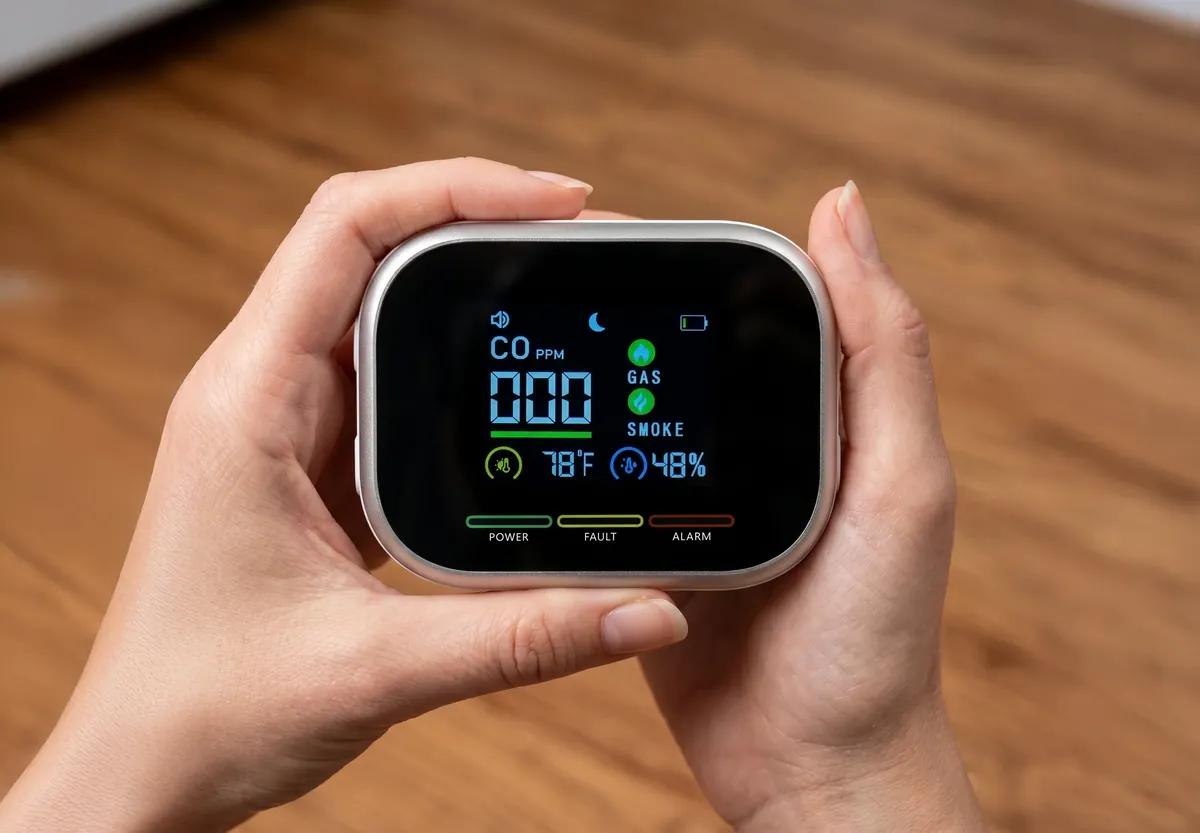
It's a compact unit that plugs directly into a standard wall outlet — no wiring, no mounting hardware. The front is a digital display showing a live CO reading in PPM, alongside separate icons for gas and smoke status, and on-unit temperature and humidity readouts. Three status lights along the bottom — Power, Fault, and Alarm — give an at-a-glance state without reading the number. A battery backup keeps the unit running through a power outage, and the seller describes continuous self-testing that runs in the background rather than requiring a manual test button press. The detection side covers four hazards in one housing: carbon monoxide, natural gas, propane, and smoke from fire.
Who CarbonOne Safe Is For
This fits a household with gas appliances — a furnace, water heater, range, or fireplace — where the actual risk of CO exposure is highest, especially in the colder months when appliances run longer and homes are sealed tighter. It also suits anyone whose current detector is old enough that they can't remember installing it; electrochemical CO sensors have a finite service life, and a detector that's quietly stopped working while its light stays on is a real, documented failure mode the seller's own material leans on (accurately) for its pitch. Renters and older adults are a reasonable fit too, given the tool-free five-second plug-in install.
It's a weaker fit if you're looking for a device to stand in for professional inspection or a properly certified detector without doing any further checking. Given the certification gap covered below, we'd treat this as a strong candidate to add to a home that's under-covered — not as a wholesale swap for an already-certified detector until you've confirmed this unit's own listing on the physical hardware.
CarbonOne Safe
Plug-in 4-in-1 detector for CO, natural gas, propane, and smoke with a live PPM display and battery backup.
$69.00 for one unit; bundle pricing drops to $62.10 (2x), $55.20 (3x, "Most Popular"), $48.30 (4x), and $41.40 per unit (5x) — free shipping at every tier. Listed against a crossed-out $138 anchor price. Seller's prices, subject to change.
✔ 90-day money-back guarantee — full refund or replacement, minus shipping and handling, not store credit.
Visit Official Page → This offer is temporarily unavailable — showing our current alternative pick.Living With It
The routine here is about as close to zero-maintenance as a safety device gets: plug it in, and the display starts showing a live reading within seconds. Placement matters more than anything you'll actively do with it — near gas appliances, in hallways outside bedrooms, and one per floor is the seller's own (reasonable) guidance. Self-testing runs automatically in the background rather than needing a monthly button press, which is a genuine convenience if it works as described, though the material never specifies what a Fault state actually reports beyond the status light itself — sensor degradation, a dead battery, or something else isn't distinguished.
What Works in Its Favor
- A live number beats a single light. Showing actual PPM instead of staying silent until a fixed alarm threshold is a real, meaningful upgrade over most detectors already installed in people's homes.
- Four hazards, one device, one outlet. Carbon monoxide, natural gas, propane, and smoke coverage in a single plug-in unit means fewer separate detectors to buy, place, and maintain.
- Setup is genuinely trivial. No tools, no electrician, no ladder — plug it in and it's running, which matters for renters and for anyone who's put off replacing an aging detector because installation felt like a chore.
- Battery backup covers the real failure window. Gas leaks and CO buildup don't pause for a power outage, and a plug-only detector with no backup goes dark exactly when risk from a generator or a furnace on backup power rises.
- The refund is cash, not store credit. The 90-day guarantee pays out as a real refund minus shipping and handling — a more buyer-friendly term than the store-credit-only guarantees we've flagged on other sales pages in similar funnels.
Honest Limitations
- No safety certification is named anywhere. Not UL 2034, not CSA 6.19-01, not ETL, not any equivalent independent listing for the CO sensor — the one credential we'd want confirmed before trusting a device sold specifically to detect a fatal gas.
- The danger statistics have no source. "100,000+ ER visits/year" and "400+ accidental deaths/year" read like CDC or NFPA figures, but nothing on the page links to where they come from.
- The competitor comparison is the seller's own framing. "5-Year Rated Lifespan" against "Up to 2 years, if you're lucky" for generic "standard detectors" is marketing copy, not a tested benchmark against any named competing product.
- Urgency elements don't reflect real scarcity. A countdown "order reservation" timer, a rolling "ship by tomorrow" line, and a permanently-applied 50%-off code against an inflated list price are standard scarcity theater, not a limited-time deal.
Key Specs
- Detection
- Carbon monoxide, natural gas, propane, and smoke (4-in-1)
- Display
- Live digital readout — CO in PPM, plus on-unit temperature and humidity
- Power
- Standard wall outlet, with battery backup during outages
- Setup
- Tool-free, roughly 5 seconds to plug in
- Rated lifespan
- 5 years, per the seller — not independently verified
- Not disclosed
- Sensor certification/listing body, battery type and capacity, exact alarm-trigger PPM, unit dimensions
Performance
The core idea — a live PPM number instead of a binary alarm light — is sound engineering logic, not marketing spin. UL-listed CO detectors are required to sound once levels hold at 70 PPM for a defined period, which means low-level, chronic exposure can go completely unflagged on a legacy device even though it can still cause headaches, fatigue, and long-term health effects. A readout that shows "23" instead of staying dark gives a household real information it wouldn't otherwise have. What we can't verify from public material alone is sensor accuracy and response time under real conditions — how close the displayed number tracks an actual calibrated reference, and how quickly it reacts to a genuine leak. That's precisely the kind of claim an independent safety certification exists to confirm, and its absence here means the "0 PPM you can trust" framing on the sales page is, for now, a claim rather than a verified fact.
What the Sales Page Gets Right — and What It Doesn't
Start with what holds up. The four-hazard coverage is stated specifically rather than vaguely, and it's an honest description of what a combination CO/gas/smoke sensor stack can do. The live-PPM concept is real and is a legitimate improvement over single-light detectors, and the install and placement guidance in the FAQ is plain and matches standard practice. The 90-day guarantee terms are stated in plain language, and — unusually for this category of sales page — they promise an actual refund rather than routing an unhappy buyer to store credit.
Where it comes apart is verification. The sensor's safety certification is never named, which for a device whose sole purpose is detecting a potentially fatal gas is the single most important thing we'd want to see and don't. The ER-visit and death statistics are presented as established fact with no citation. The five-year-versus-two-year lifespan comparison is the seller's own claim about unnamed "standard detectors," not a tested result. And the page leans on manufactured urgency — a countdown timer, rotating "low stock" messaging, and a permanently-applied discount code against an inflated list price — mechanics that exist to speed up a purchase decision, not to inform one.
Verdict
CarbonOne Safe gets the format right: a live PPM readout across four hazard types, in a device you can install in five seconds, with a battery backup and a guarantee that actually pays cash. That's a genuine step up from the detector most people already have and have forgotten about. But the sales page never names the one credential that would let us treat its core safety claim as verified rather than asserted — an independent listing for the CO sensor — and it fills that gap with uncited statistics and manufactured urgency instead. At $69 for a single unit with a real 90-day refund, it's a low-risk way to add live-reading coverage to a home that's under-detected. We wouldn't rely on it as your only line of defense in a room with a gas appliance, though — check the physical unit for a certification mark once it arrives, and keep an already-certified detector in place until you've confirmed one.
This review reflects our independent editorial opinion based on publicly available product information — see how we test and our Editorial Policy. GearGlobes may earn a commission from qualifying purchases; see our Affiliate Disclosure.
Frequently Asked Questions
Does CarbonOne Safe replace my existing smoke or CO detector?
We wouldn't treat it as a straight replacement yet. The sales page never names an independent safety listing — UL 2034, CSA 6.19-01, ETL, or an equivalent — for the CO sensor, which is the credential that tells you a detector has been independently tested to actually alarm when it should. Check the physical unit and box for a certification mark once it arrives, and until you've confirmed one, use it alongside an already-certified detector rather than in place of it.
What does the number on the screen actually mean?
It's a live carbon monoxide reading in parts per million (PPM), plus separate gas and smoke status icons and on-unit temperature and humidity. Zero means clean air; the number rises as CO accumulates. The seller doesn't publish the exact PPM level that triggers the alarm, which is worth knowing since UL-listed detectors are required to sound at a defined, tested threshold.
How many units does a typical house need?
The seller's own FAQ suggests one per floor, plus one near gas appliances like a furnace, water heater, or stove, and one outside each sleeping area — most homes land at 2 to 4 units. That placement guidance matches standard CO-detector practice generally, independent of this specific product.
What happens during a power outage?
A built-in battery keeps the unit running and monitoring when the power goes out, according to the seller. This matters because gas leaks and CO buildup don't pause during outages, and a plug-only detector with no backup goes dark exactly when a furnace running on backup power or a generator raises real risk.
Is the current price actually 50% off?
Treat the crossed-out $138 as marketing framing, not a price you'd otherwise pay. At checkout a single unit runs $69, dropping to $62.10, $55.20, $48.30, and $41.40 per unit as you add more (2 through 5 units), with free shipping at every tier and a permanently-applied SAFE26 promo code. The "ends at midnight" countdown resets rather than expiring, which is a standard urgency tactic worth ignoring when you decide how many to buy.
Is the 90-day guarantee a real refund?
As stated at checkout, yes — it's a money-back guarantee, not store credit: send the item back in its original packaging within 90 days for a full refund or replacement, minus shipping and handling. That's more favorable than some sales pages in this category, which route refunds to store credit instead of cash.
Ready to try CarbonOne Safe?
See current pricing, bundle deals, and availability on the official page.
Read the full CarbonOne Safe Overview for specs, how it works, and where to buy — or browse more picks in Gas & CO Detectors.
Ava covers home comfort and smart-home tech at GearGlobes. Her reviews separate what a product actually does from how it's marketed, flagging claims that can't be independently verified rather than repeating them as fact.